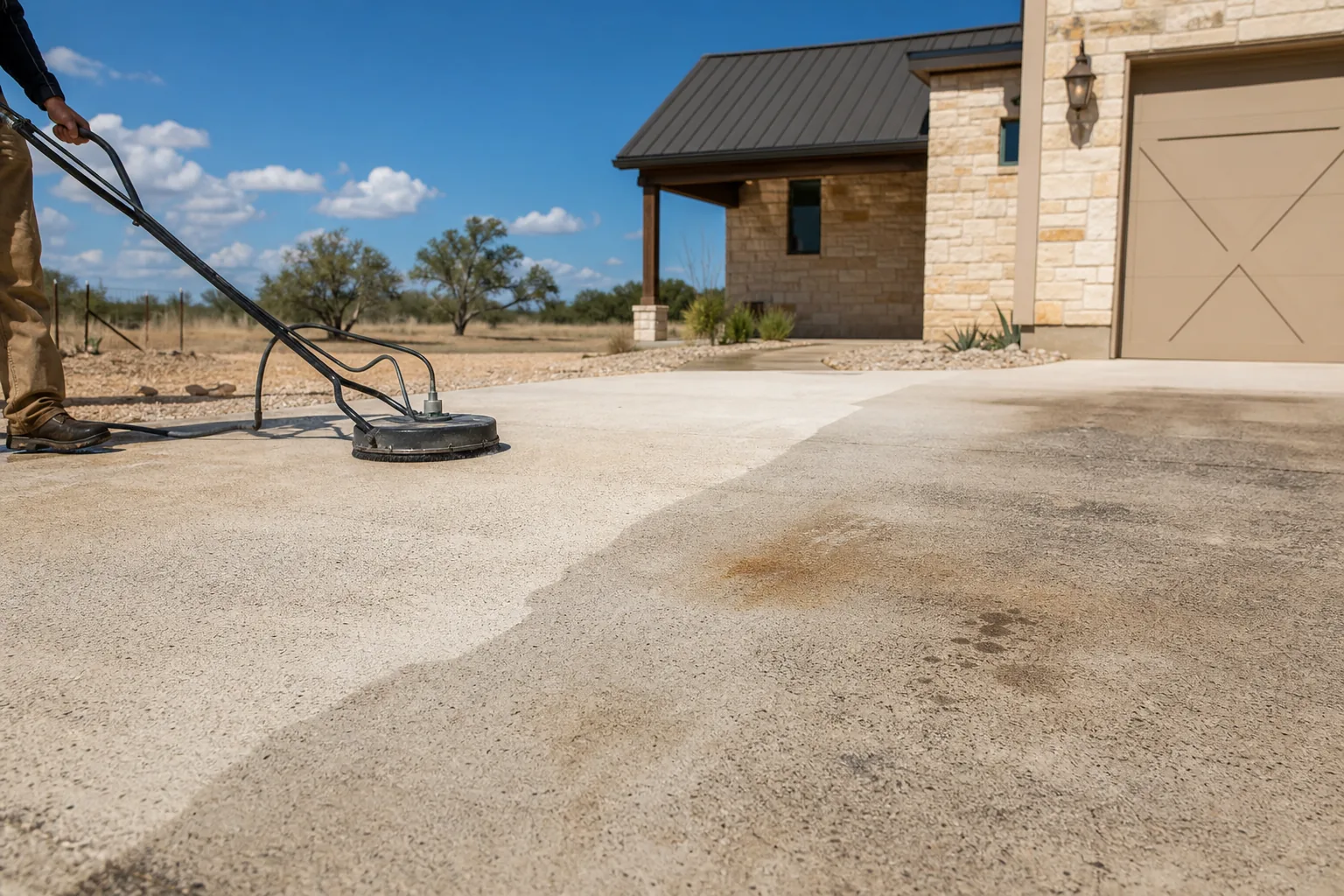
General exterior cleaning is strongest at removing material sitting on the surface. It cannot reverse every chemical reaction, coating failure, or physical defect beneath that material.
Buildup that commonly cleans well
Loose soil, windblown dust, cobwebs, many organic films, surface grime, and ordinary atmospheric residue often respond well to the correct combination of treatment, dwell time, agitation, and rinsing. The exact approach changes between concrete, siding, stone, stucco, roofing, and wood.
Dark organic buildup may disappear dramatically. That does not mean every dark mark has the same cause. Moisture patterns, exhaust, irrigation, tire wear, and material aging can look similar from a distance, so identification matters.
Stains need more than “more pressure”
Oil, grease, rust, battery residue, paint, gum, fertilizer marks, efflorescence, mineral scale, and irrigation stains are specialty concerns. Some can be substantially improved with targeted treatment; some penetrate porous material or chemically alter it. Aggressive pressure cannot reliably substitute for the correct chemistry and may make the surrounding surface look worse.
The age, depth, source, previous treatment, and porosity of a stain all affect how much can safely be removed.
Conditions cleaning does not repair
- Oxidation: chalky or faded pigment is a change in the coating, not dirt. Uneven disturbance can create visible streaking.
- Etching and wear: altered concrete paste, exposed aggregate, tire abrasion, and historical pressure marks remain part of the slab.
- Paint or coating failure: loose, peeling, blistered, or sun-damaged finishes need coating work after suitable preparation.
- Cracks and spalling: cleaning can reveal these conditions but does not repair them.
- Permanent fading: ultraviolet exposure changes dyes, stains, plastics, roofing, and painted surfaces over time.
- Moisture or drainage causes: cleaning removes symptoms; it does not correct the leak, irrigation pattern, or grading issue that caused them.
What changes the final result
New stains usually respond better than old ones. Dense surfaces release contamination more readily than porous ones. Sealed concrete behaves differently from bare concrete. A previously painted wall may have multiple coating systems and repairs. Heat can accelerate drying, while wind can shorten useful dwell time. These variables are why a small test area and honest expectations matter.
There is also a contrast effect: once surrounding dirt is removed, a permanent rust shadow or old repair may become more noticeable. That is not necessarily new damage; it may simply be easier to see against the clean surface.
Share useful details before an estimate
Photograph the entire area and a close view of the concern. Explain what caused it, if known; how long it has been present; what products have already been tried; and whether the surface is coated or sealed. Ask whether the proposed scope is general cleaning, specialty stain treatment, or restoration.
A responsible goal may be “uniformly cleaner” rather than “like new.” The right expectation protects the surface and makes the final result easier to evaluate fairly.
Have questions about a driveway or walkway?
Explore concrete cleaning